



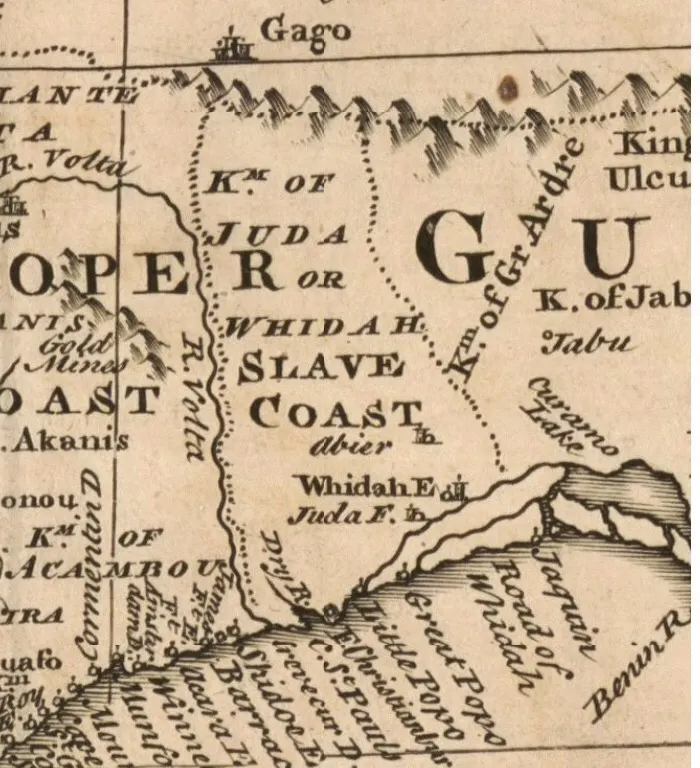
The 1747 map A New and Accurate Map of Negroland and the Adjacent Countries by Emanuel Bowen marks a section of West Africa as the Kingdom of Juda or Whidah (Slave Coast) (Library of Congress). This map is evidence that European cartographers knew exactly who they were targeting. They labeled the region “Juda” because the people there identified as descendants of the Israelites.


That region, located in what is now southern Benin, was the same place known in colonial records as the Slave Coast. The Kingdom of Whydah, also spelled Whidah or Juda, was a major hub of the Atlantic slave trade, exporting over a million Africans between the 1600s and 1800s (Wikipedia: Kingdom of Whydah). The label “Juda” directly connects to the tribe of Judah. European mapmakers recorded what they already knew from African oral traditions and local informants.
Among the peoples of that region were the Igbo, who maintain strong oral traditions of Israelite descent. Olaudah Equiano, an Igbo man enslaved and later freed, wrote in 1789 that “the strong analogy which appears to prevail in the manners and customs of my countrymen and those of the Jews” was unmistakable (Guardian Nigeria). Many Igbo today continue to uphold that connection, practicing customs similar to those of ancient Israel (Aish.com).
The Bible was already complete centuries before the slave trade began. Judaism and Christianity were deeply rooted across Africa, from Egypt and Ethiopia to West Africa. After the fall of the Second Temple in 70 CE, groups of Israelites dispersed southward into Africa. The descendants of those migrations lived in the regions European ships would later reach.
When these Africans were captured and enslaved, they did not forget who they were. They carried that memory in spirit and song. In the Americas, they created Negro spirituals like Go Down Moses and Let My People Go (Wikipedia: Go Down Moses). These songs are not borrowed stories but declarations of identity, expressing the same cry for deliverance as their ancestors in Egypt.
The evidence aligns. The map marks Judah. The oral histories in Africa remember Judah. The songs in America sing Judah. Europeans knew who they were kidnapping, and the people of Judah never forgot who they were.


51 Comments
I don’t think the title of your article matches the content lol. Just kidding, mainly because I had some doubts after reading the article.
Can you be more specific about the content of your article? After reading it, I still have some doubts. Hope you can help me.
Your article helped me a lot, is there any more related content? Thanks! https://accounts.binance.com/kz/register-person?ref=K8NFKJBQ
Thank you for your sharing. I am worried that I lack creative ideas. It is your article that makes me full of hope. Thank you. But, I have a question, can you help me?
Thank you for your sharing. I am worried that I lack creative ideas. It is your article that makes me full of hope. Thank you. But, I have a question, can you help me? https://www.binance.info/fr/register?ref=T7KCZASX
Thank you for your sharing. I am worried that I lack creative ideas. It is your article that makes me full of hope. Thank you. But, I have a question, can you help me?
Thank you for your sharing. I am worried that I lack creative ideas. It is your article that makes me full of hope. Thank you. But, I have a question, can you help me?
Thanks for sharing. I read many of your blog posts, cool, your blog is very good.
I don’t think the title of your article matches the content lol. Just kidding, mainly because I had some doubts after reading the article. https://www.binance.com/register?ref=IHJUI7TF
Thanks for sharing. I read many of your blog posts, cool, your blog is very good.
Can you be more specific about the content of your article? After reading it, I still have some doubts. Hope you can help me.
Reading your article helped me a lot and I agree with you. But I still have some doubts, can you clarify for me? I’ll keep an eye out for your answers. https://www.binance.com/register?ref=IXBIAFVY
Thank you for your sharing. I am worried that I lack creative ideas. It is your article that makes me full of hope. Thank you. But, I have a question, can you help me?
Thanks for sharing. I read many of your blog posts, cool, your blog is very good.
Your point of view caught my eye and was very interesting. Thanks. I have a question for you.
Your point of view caught my eye and was very interesting. Thanks. I have a question for you.
Your point of view caught my eye and was very interesting. Thanks. I have a question for you. https://accounts.binance.com/register-person?ref=QCGZMHR6
Thank you for your sharing. I am worried that I lack creative ideas. It is your article that makes me full of hope. Thank you. But, I have a question, can you help me? https://accounts.binance.com/en-ZA/register-person?ref=B4EPR6J0
Your point of view caught my eye and was very interesting. Thanks. I have a question for you.
Can you be more specific about the content of your article? After reading it, I still have some doubts. Hope you can help me. https://www.binance.com/register?ref=IHJUI7TF
I don’t think the title of your article matches the content lol. Just kidding, mainly because I had some doubts after reading the article.
Your article helped me a lot, is there any more related content? Thanks!
Your article helped me a lot, is there any more related content? Thanks! https://accounts.binance.info/ro/register-person?ref=HX1JLA6Z
Thanks for sharing. I read many of your blog posts, cool, your blog is very good. https://www.binance.com/de-CH/register?ref=W0BCQMF1
Thanks for sharing. I read many of your blog posts, cool, your blog is very good. https://accounts.binance.info/es-AR/register-person?ref=UT2YTZSU
Your point of view caught my eye and was very interesting. Thanks. I have a question for you.
Thanks for sharing. I read many of your blog posts, cool, your blog is very good.
Can you be more specific about the content of your article? After reading it, I still have some doubts. Hope you can help me.
Thanks for sharing. I read many of your blog posts, cool, your blog is very good.
Thanks for sharing. I read many of your blog posts, cool, your blog is very good. https://www.binance.info/pl/register?ref=UM6SMJM3
I don’t think the title of your article matches the content lol. Just kidding, mainly because I had some doubts after reading the article.
Your article helped me a lot, is there any more related content? Thanks!
Your article helped me a lot, is there any more related content? Thanks! https://accounts.binance.bh/register/person?ref=IHJUI7TF
Your article helped me a lot, is there any more related content? Thanks!
I don’t think the title of your article matches the content lol. Just kidding, mainly because I had some doubts after reading the article.
Thanks for shening. I read many of your blog posts, cool, your blog is very good.
I don’t think the title of your article matches the content lol. Just kidding, mainly because I had some doubts after reading the article.
I don’t think the title of your article matches the content lol. Just kidding, mainly because I had some doubts after reading the article.
Your article helped me a lot, is there any more related content? Thanks!
Your point of view caught my eye and was very interesting. Thanks. I have a question for you.
Can you be more specific about the content of your article? After reading it, I still have some doubts. Hope you can help me.
Thank you for your sharing. I am worried that I lack creative ideas. It is your article that makes me full of hope. Thank you. But, I have a question, can you help me?
Thanks for sharing. I read many of your blog posts, cool, your blog is very good.
Your point of view caught my eye and was very interesting. Thanks. I have a question for you.
Thanks for sharing. I read many of your blog posts, cool, your blog is very good.
Your article helped me a lot, is there any more related content? Thanks!
Your article helped me a lot, is there any more related content? Thanks! 开设Binance账户
Your article helped me a lot, is there any more related content? Thanks! Binance开户
I don’t think the title of your article matches the content lol. Just kidding, mainly because I had some doubts after reading the article.
Thanks for sharing. I read many of your blog posts, cool, your blog is very good. 创建个人账户
Thanks for sharing. I read many of your blog posts, cool, your blog is very good. https://businessinconline.com/dropshipping-in-business-e-commerce/?unapproved=3651&moderation-hash=b132ccee93ab2c14cbbd955499d4ebe1#comment-3651