
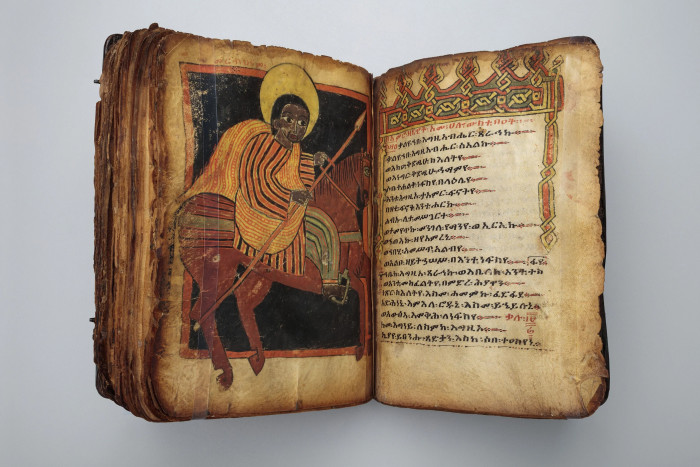
Long before modern racial ideology hardened in the nineteenth century, European scholars did not treat Africa as spiritually empty or historically disconnected from the Bible. In fact, many mainstream European atlases, travel accounts, missionary writings, and works of biblical ethnography openly placed Black Africans inside Israelite and biblical history. This was not fringe thinking. It was normal scholarship for the period.
One of the clearest examples is the eighteenth century geography volume Atlas Geographus. In its Africa volume, the author states plainly that Judaism was the religion of ancient Africans for a long time and that it predated both Christianity and Islam on the continent. The text treats this as historical background, not speculation. It assumes an African familiarity with biblical law, literacy, and religious continuity.
This worldview was common at the time. European writers routinely identified Ethiopians, Nubians, Egyptians, Berbers, and even West African peoples with Israelites or closely related biblical populations. Hiob Ludolf’s works on Ethiopia, including Historia Aethiopica, treated Ethiopian Judaism and Christianity as inheritances from ancient Israel rather than later inventions. Samuel Bochart’s Geographia Sacra placed Africa at the center of biblical geography and lineage, not on the margins.
Travel writers echoed the same assumptions. William Bosman and William Smith, writing about the Guinea Coast, repeatedly compared West African customs to Mosaic law. They did not describe these similarities as coincidences or recent conversions. They described them as survivals. Paul Rycaut’s The History of the Jews discussed Black Jewish communities in Africa as ancient and indigenous. Leo Africanus, whose Description of Africa remained influential for centuries, openly described Jewish African kingdoms as historical fact.
What matters here is not whether every claim in these books is correct by modern standards. What matters is what these authors believed and taught. They did not view Black Africans as outside of sacred history. They did not assume Africans were naturally pagan or incapable of civilization. They routinely acknowledged African antiquity, literacy, religion, and connection to Israel.
This began to change in the late eighteenth and nineteenth centuries. As transatlantic slavery expanded and colonial empires hardened, European scholarship shifted. Biblical ethnography gave way to racial science. Africans were reclassified from ancient peoples with history into biological categories designed to justify permanent subjugation. Earlier acknowledgments were quietly dropped, reframed, or dismissed as error.
The erasure was not accidental. A people identified as ancient Israelites could not easily be reduced to livestock. Recognizing Black biblical identity conflicted with the economic and political needs of empire. So history was rewritten.
The value of sources like Atlas Geographus is not that they prove every African was an Israelite. They do not. Their value is that they expose a historical truth that later ideology tried to bury. Before modern racism, Europeans themselves placed Black Africans inside the biblical world. That fact alone dismantles the myth that African connection to Israel is a modern invention.
Africa was never outside history. It was written out.
Sources:
Atlas Geographus. Vol. IV Africa. Herman Moll associated editions. London. Early 1700s.
A New and Accurate Description of the Coast of Guinea. London. 1705.
Historia Aethiopica. Frankfurt. 1681.
The Present State of Ethiopia. London English editions early 1700s.
Geographia Sacra. Caen. 1646.
An Universal History from the Earliest Account of Time. London. 1736 to 1747 editions.
The System of Geography. London. 1701.
The History of the Jews. London. 1708.
Description of Africa. 16th to 18th century European editions.
Bibliotheca Orientalis. Paris. 1697.
The Natural History of the Bible. Boston. 1797.
Chronica Mundi. London. 1614.
An Historical Account of Guinea. London. 1744.
Geographical Grammar. London. 1749.
Ethiopian Royal Chronicles. European translations and compilations. 17th and 18th centuries.
