
A Timeline of Erasure and Reclaiming
Egypt’s African Empire (2700–1070 BCE)
Across the Old, Middle, and New Kingdoms, Egypt ruled lands reaching deep into Nubia and far north through Sinai into Canaan. Temples, governors, and trade routes tied everything from the Nile to the Levant under African control. The lands that would later be called Israel and Palestine were African-ruled for almost two thousand years.
Greek Witness (5th–4th centuries BCE)
Greek historians like Herodotus and philosophers like Aristotle described Egyptians and Ethiopians as dark-skinned peoples, confirming that the world saw Egypt as part of Africa and its people as Black. Classical testimony left no ambiguity about Egypt’s African identity.
Medieval Maps and the Unified Worldview (7th–14th centuries CE)
European T-and-O maps, including the Hereford Mappa Mundi (c. 1300), divided the earth into Africa, Europe, and Asia meeting at Jerusalem. These medieval depictions kept the Holy Land tied to Africa, with no separation between African and Levantine soil.
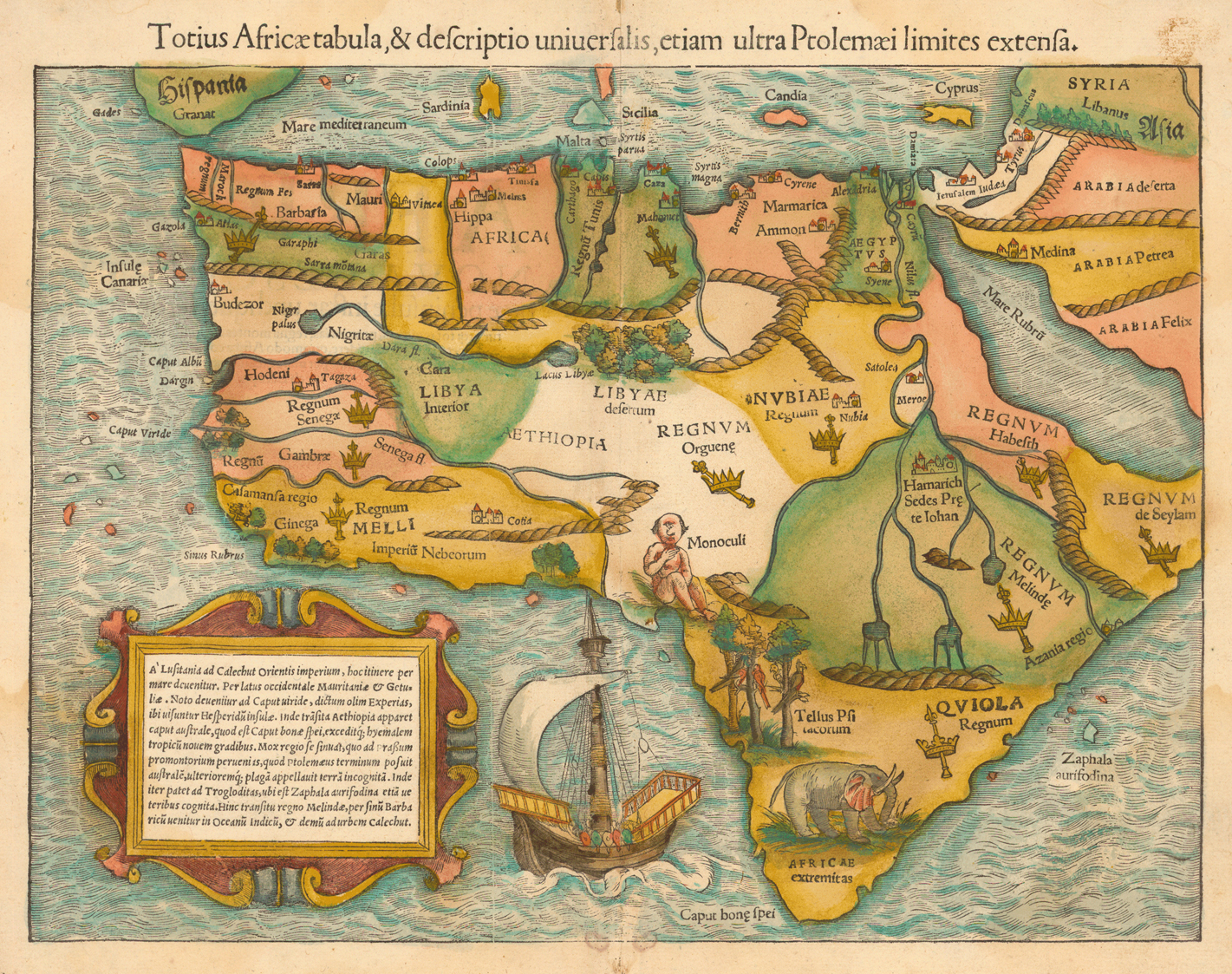
Renaissance Mapping of Africa (1540 CE)
Sebastian Münster’s Africae Tabula Nova defined Africa broadly. Regions near today’s Holy Land appeared within Africa’s frame, showing that early modern cartographers still treated that geography as African territory, not Asian.
Negroland and the Kingdom of Juda (1747 CE)
Jean Baptiste d’Anville’s Map of Negroland marked a Kingdom of Juda along the West African coast, visually tying West Africa to ancient Hebrew heritage. The cartographic link reinforced African claims to biblical ancestry.
Olaudah Equiano’s Testimony (1789 CE)
In The Interesting Narrative of the Life of Olaudah Equiano, the Igbo abolitionist described his people’s practices of circumcision, purification, and dietary laws as identical to Hebrew customs, asserting that Africans descended from the ancient Israelites.
Africa’s Boundaries Before Colonization (1822 CE)
Early nineteenth-century maps like Morse’s Africa continued to include the Holy Land inside the African continental frame. The African context of Jerusalem remained normal cartography before Western imperial powers intervened.
The Colonial Rebrand: “Middle East” (1850s–1902 CE)
British officials first used “Middle East” while administering India in the mid-nineteenth century. U.S. naval strategist Alfred Thayer Mahan popularized it in 1902. The label was a geopolitical invention that shifted sacred geography out of Africa and into a newly imagined “Asia Minor” to suit colonial strategy.
The Suez Canal and the Great Divide (1869 CE)
When Europeans carved the Suez Canal through Egypt, they physically and symbolically sliced Africa apart. Within decades, European atlases redrew boundaries excluding the Holy Land from Africa—an act of political geography that served empire, not truth.
European Jewish Migration to Palestine (1881–1914 CE)
The first large wave of European, primarily Russian and Eastern European, Jews began moving into Palestine during what became known as the First Aliyah (1881–1903). They were fleeing pogroms and persecution in the Russian Empire. A second wave, the Second Aliyah (1904–1914), brought thousands more settlers influenced by early Zionist ideology.
Zionism and the Political Foundation (1890s–1940s CE)
Modern Zionism emerged in Europe in the late 19th century. Nathan Birnbaum coined the term “Zionism” in 1890, and Theodor Herzl organized the First Zionist Congress in Basel in 1897, establishing the World Zionist Organization. European political lobbying for a Jewish homeland intensified under British protection during and after World War I, especially after the Balfour Declaration of 1917.
Institutionalizing the “Middle East” (1930s–1940s CE)
During World War II, Britain and the United States formalized the term in military and diplomatic usage. Western cartography finished the separation: Jerusalem and the surrounding lands were officially detached from Africa.
The State of Israel (1948 CE)
Following British withdrawal from Palestine, the Zionist leadership declared the creation of the State of Israel on May 14, 1948. The declaration came less than eighty years after the first Russian settlers began arriving. It was recognized by the United States and the Soviet Union within days, cementing a new geopolitical order rooted in European colonial restructuring.
Geological Truth: The African Plate (20th Century–Present)
Modern tectonic studies confirm that Israel, Palestine, Lebanon, and western Jordan lie on the African Plate, not the Asian one. The Dead Sea Transform marks the boundary where the African and Arabian plates meet. The land called “the Middle East” literally rests on African ground.
Conclusion
For millennia the Holy Land was African in rule, culture, and even bedrock. Only in the past century and a half did Western powers redraw it for colonial convenience. The language of the “Middle East,” the creation of Israel, and the borders that followed were inventions serving empire. The earth itself—through its tectonic plates—still tells the original story: the Holy Land remains African.
Key Sources
Herodotus, Histories, Book II
Aristotle, Physiognomonica
Hereford Mappa Mundi (c. 1300 CE), Hereford Cathedral
Sebastian Münster, Africae Tabula Nova (1540 CE)
Jean Baptiste d’Anville, Map of Negroland and the Guinea Coast (1747 CE)
Olaudah Equiano, The Interesting Narrative of the Life of Olaudah Equiano (1789 CE)
Alfred Thayer Mahan, “The Persian Gulf and International Relations,” National Review (1902)
United States Geological Survey: “African Plate” and “Dead Sea Transform” pages
U.S. State Department Archives, 1940s wartime “Middle East Command” records
First and Second Aliyah records (1881–1914)
Theodor Herzl, Der Judenstaat (1896)
Balfour Declaration (1917)
United Nations Resolution 181 (1947)

138 Comments
Start earning passive income—become our affiliate partner!
Thanks for sharing. I read many of your blog posts, cool, your blog is very good.
Your article helped me a lot, is there any more related content? Thanks!
Thank you for your sharing. I am worried that I lack creative ideas. It is your article that makes me full of hope. Thank you. But, I have a question, can you help me? https://accounts.binance.com/pl/register?ref=UM6SMJM3
Can you be more specific about the content of your article? After reading it, I still have some doubts. Hope you can help me.
Thanks for sharing. I read many of your blog posts, cool, your blog is very good.
I don’t think the title of your article matches the content lol. Just kidding, mainly because I had some doubts after reading the article.
Thank you for your sharing. I am worried that I lack creative ideas. It is your article that makes me full of hope. Thank you. But, I have a question, can you help me?
Can you be more specific about the content of your article? After reading it, I still have some doubts. Hope you can help me.
Can you be more specific about the content of your article? After reading it, I still have some doubts. Hope you can help me. https://accounts.binance.com/register-person?ref=IHJUI7TF
Join our affiliate community and maximize your profits!
Thank you for your sharing. I am worried that I lack creative ideas. It is your article that makes me full of hope. Thank you. But, I have a question, can you help me? https://www.binance.com/register?ref=IHJUI7TF
Thank you for your sharing. I am worried that I lack creative ideas. It is your article that makes me full of hope. Thank you. But, I have a question, can you help me?
Can you be more specific about the content of your article? After reading it, I still have some doubts. Hope you can help me. https://accounts.binance.com/pl/register?ref=UM6SMJM3
I don’t think the title of your article matches the content lol. Just kidding, mainly because I had some doubts after reading the article. https://accounts.binance.com/zh-CN/register-person?ref=WFZUU6SI
Your point of view caught my eye and was very interesting. Thanks. I have a question for you.
Thanks for sharing. I read many of your blog posts, cool, your blog is very good. https://www.binance.info/register?ref=JW3W4Y3A
Thanks for sharing. I read many of your blog posts, cool, your blog is very good.
Join our affiliate community and earn more—register now!
Thank you for your sharing. I am worried that I lack creative ideas. It is your article that makes me full of hope. Thank you. But, I have a question, can you help me?
Can you be more specific about the content of your article? After reading it, I still have some doubts. Hope you can help me.
Thanks for sharing. I read many of your blog posts, cool, your blog is very good.
Your point of view caught my eye and was very interesting. Thanks. I have a question for you.
Earn up to 40% commission per sale—join our affiliate program now!
Your article helped me a lot, is there any more related content? Thanks! https://www.binance.com/es-MX/register?ref=GJY4VW8W
Your article helped me a lot, is there any more related content? Thanks!
I don’t think the title of your article matches the content lol. Just kidding, mainly because I had some doubts after reading the article.
Your point of view caught my eye and was very interesting. Thanks. I have a question for you. https://www.binance.info/register?ref=IXBIAFVY
ко ланта ko lanta
Can you be more specific about the content of your article? After reading it, I still have some doubts. Hope you can help me.
Thanks for sharing. I read many of your blog posts, cool, your blog is very good. https://accounts.binance.com/register-person?ref=IHJUI7TF
https://shorturl.fm/Sjhyh
Can you be more specific about the content of your article? After reading it, I still have some doubts. Hope you can help me.
Can you be more specific about the content of your article? After reading it, I still have some doubts. Hope you can help me. https://accounts.binance.info/si-LK/register-person?ref=LBF8F65G
https://n-russia.ru/the_articles/derevyannye_mezhkomnatnye_dveri_massiv_ili_shpon.html
https://myfreedom.ru/articles/raznoe/kukhni-pod-zakaz-chto-vybrat-gotovuyu-kukhnyu-ili-individualnyj-proekt.html
https://shorturl.fm/BOmZZ
https://maks.su/
https://maks.su/media-buying/networks-rtbs/
https://shorturl.fm/tCFjd
https://maks.su/media-buying/social-search/
https://shorturl.fm/GRKhJ
I don’t think the title of your article matches the content lol. Just kidding, mainly because I had some doubts after reading the article.
https://shorturl.fm/uXY7o
https://shorturl.fm/umFFv
Your article helped me a lot, is there any more related content? Thanks!
https://shorturl.fm/eomzt
https://shorturl.fm/YnMne
https://shorturl.fm/PDkQJ
зеркало стейк stake официальный сайт
Thank you for your sharing. I am worried that I lack creative ideas. It is your article that makes me full of hope. Thank you. But, I have a question, can you help me? https://www.binance.info/register?ref=IXBIAFVY
овальная акриловая ванна акриловый ванна купить цена
Мастер кресел Москва Если вы ищете надежного мастера по ремонту кресел в Москве, который поможет починить ваше компьютерное или офисное кресло с выездом, обращайтесь за профессиональной помощью, чтобы продлить срок службы вашей мебели и обеспечить максимальный комфорт во время работы или игр.
Аренда автомобиля премиум-класса с водителем в Москве Мы предлагаем гибкие условия аренды, от почасовой до долгосрочной, включая аренду на один день, два дня, неделю, месяц и даже два месяца, охватывая как поездки по Москве, так и междугородние маршруты
торговые боты Каждое утро свежие комбо и коды в телеграмме. Заработок на крипто играх, майнинг на телефоне, раздача бесплатной криптовалюты. Ежедневный фарм без вложений. Забирай daily codes и будь в плюсе.
Ремонт промышленных холодильников Профессиональный ремонт аудиотехники в Алматы. Перемотка динамиков, замена подвесов и ремонт кроссоверов.Ремонт колонок Алматы
техосмотр спб Будь то экспресс-техосмотр онлайн или плановая проверка в нашем центре, мы гарантируем профессиональный подход и полное соответствие всем нормам
трансы Екатеринбург Иркутск, с его живописными окрестностями, и оживленный Пермь, являясь центрами притяжения для многих, также становятся сценой для зарождения разнообразных отношений.
ботинки защитные для мужчин цена Рабочие ботинки с подноском, будь то металлический, композитный или усиленный, становятся незаменимыми для строителей, работников производства, складских комплексов и всех, чья деятельность связана с потенциальными рисками для ног.
https://shorturl.fm/0eqi9
кайт сафари
Your article helped me a lot, is there any more related content? Thanks!
Your point of view caught my eye and was very interesting. Thanks. I have a question for you. https://www.binance.bh/register?ref=QCGZMHR6
кайт сафари
трансы Волгоград трансы Волгоград
blsp at
Klikko.pro — биржа заданий для продвижения в соцсетях. Исполнители зарабатывают на лайках, подписках и просмотрах, заказчики получают живую активность. Вывод на карту, PayPal и крипту.
https://klikko.pro/kak-nakrutit-prosmotry-v-tg-kanale
девушки Донецк Знакомства Донецк
сайт selector gg
https://silavmisli.ru/wp-content/pgs/?kakie_napitki_luchshe_vsego_pity_do_i_posle_prinyatiya_vanny.html
новости в Петербурге Погрузитесь в эксклюзивные репортажи новостей Петербург, где каждый аспект жизни города освещается с особой детальностью, позволяя почувствовать пульс города.
tez888 tez888
Thank you for your sharing. I am worried that I lack creative ideas. It is your article that makes me full of hope. Thank you. But, I have a question, can you help me?
http://369electronics.com/1xbet-free-bet-promo-code-today-egypt-2026-1xtower/
Domain abuse
кайтинг в хургаде обучение кайтсерфингу
https://argayash.com/pag/1xbet_kazino_promokod.html
https://shorturl.fm/dYBYp
https://shorturl.fm/jvprr
https://shorturl.fm/tx2IK
Can you be more specific about the content of your article? After reading it, I still have some doubts. Hope you can help me.
Thanks for sharing. I read many of your blog posts, cool, your blog is very good.
https://shorturl.fm/cXNBb
Thank you for your sharing. I am worried that I lack creative ideas. It is your article that makes me full of hope. Thank you. But, I have a question, can you help me? https://www.binance.bh/futures/ref?code=L4EUT9FG
мебель из массива дерева
https://inspro.pro/product/4/
I don’t think the title of your article matches the content lol. Just kidding, mainly because I had some doubts after reading the article.
https://shorturl.fm/HZfk1
Thanks for sharing. I read many of your blog posts, cool, your blog is very good.
Thanks for sharing. I read many of your blog posts, cool, your blog is very good. https://www.binance.com/register?ref=JW3W4Y3A
I don’t think the title of your article matches the content lol. Just kidding, mainly because I had some doubts after reading the article. https://accounts.binance.info/register/person?ref=IXBIAFVY
https://shorturl.fm/nu16E
Стоматология одинцово
https://shorturl.fm/GOEn8
Your point of view caught my eye and was very interesting. Thanks. I have a question for you.
рыбная ферма под ключ
кормушка для пруда
I don’t think the title of your article matches the content lol. Just kidding, mainly because I had some doubts after reading the article.
Thank you for your sharing. I am worried that I lack creative ideas. It is your article that makes me full of hope. Thank you. But, I have a question, can you help me?
Thanks for sharing. I read many of your blog posts, cool, your blog is very good.
Your point of view caught my eye and was very interesting. Thanks. I have a question for you.
https://shorturl.fm/hER4R
https://shorturl.fm/tSpX8
I don’t think the title of your article matches the content lol. Just kidding, mainly because I had some doubts after reading the article.
https://shorturl.fm/wDgk4
Thank you for your sharing. I am worried that I lack creative ideas. It is your article that makes me full of hope. Thank you. But, I have a question, can you help me?
https://shorturl.fm/6pVV6
Thanks for sharing. I read many of your blog posts, cool, your blog is very good.
https://shorturl.fm/VCalA
https://shorturl.fm/LFEpV
Your point of view caught my eye and was very interesting. Thanks. I have a question for you.
https://shorturl.fm/fvboV
Thanks for sharing. I read many of your blog posts, cool, your blog is very good.
https://shorturl.fm/pn0CD
https://shorturl.fm/bORKm
https://shorturl.fm/c46dJ
Your point of view caught my eye and was very interesting. Thanks. I have a question for you.
Can you be more specific about the content of your article? After reading it, I still have some doubts. Hope you can help me.
I don’t think the title of your article matches the content lol. Just kidding, mainly because I had some doubts after reading the article.
https://shorturl.fm/CmtaF
Thanks for sharing. I read many of your blog posts, cool, your blog is very good.
Can you be more specific about the content of your article? After reading it, I still have some doubts. Hope you can help me.
Hi gamers, I just figured to drop a thing I randomly discovered while checking online gaming news. After another long PC gaming grind, I opened one post about a modern internet-based casino that supposedly has an cross-border operating license.
I not here to sell gambling, but from the perspective of a person who spends too much time online, I found the topic interesting. The main thing that caught my attention was that the writer described the site as international. Of course, that does never mean that all users can join inside every place. National restrictions still matter, and every player should verify the local terms before trying it.
Still, the angle sounded pretty modern. The article said that the site was made for players from many locations, with options that appear more international than older casino sites. It pointed out about simple account creation, smooth UX, smartphone access, and multiple payment systems.
As a PC gamer, I always notice the interface first. When a site is slow, I usually stop caring basically instantly. The article made the platform sound modern, which is important because today users are used to fast apps. A outdated interface can kill even a interesting platform.
The license part was also the main reason I kept reading. There are so many questionable casino sites on the internet, and plenty of of them push loud statements without showing much. So when an article mentions recognized licensing, that somewhat makes me read further. But again, personally I would still confirm the license number myself before joining anything.
The article also described entertainment variety. It sounded like the casino has slot games, traditional casino games, and dealer-based table games. I know gambling titles are not the same from MMOs, but there is still some similarity in how apps try to keep users engaged. Things like rewards, daily promos, and instant feedback loops are visible in both gaming.
One thing I appreciated in the article was that it also bring up controlled gambling. This is necessary, because cash are involved. Playing should stay safe, not become dangerous. The article referred to things like account limits, pause features, and safety settings. In my opinion, any professional casino platform should have those tools by default.
Another notable part was the cross-border audience. The article made it sound like the platform is not only focused on one market, but on many markets. That sounds interesting, especially for people who live abroad, but it also means users need to be responsible. Cross-border does never automatically mean legal everywhere. There are usually blocked countries, and those lists should be read before creating an account.
I also thought about how gambling sites are becoming more like entertainment hubs. They focus on design, personalization, and simple use. For older casino websites, the experience sometimes felt confusing. But newer ones seem to understand that gamers expect high-quality design. This does not make a casino automatically safe, but it does show that the platform is at least thinking about convenience.
The money side also sounded somewhat useful. The article mentioned that the platform supports various transaction options, which is useful for global users. But that is another area where people should check the limits. Payout rules are very important, because a site can look polished, but if withdrawals are limited, then the experience becomes annoying.
To be clear, I am not to say this site is perfect. I just found the write-up different because it shows how the regulated entertainment industry is moving. More platforms are trying to look trustworthy, and more of them are using entertainment-focused design. For people who follow online entertainment, that is kind of interesting to watch.
Has anyone else here read similar news about international online casinos? Do you think cross-border availability actually makes a big difference, or do you mostly care about withdrawals? I am mainly curious from the online entertainment perspective, not trying to sell anyone. And, of course, if someone decides to join any casino site, they should confirm local laws, read the terms, protect their budget, and spend responsibly.
Your point of view caught my eye and was very interesting. Thanks. I have a question for you. “oppna binance-konto
https://shorturl.fm/Yi6tn
I am from Australia and not long ago I decided to try VegaZone Casino purely out of a sense of curiosity. Initially, I paid attention to the platform as a whole: everything looks quite polished, it isn’t hard to navigate, and what you’re looking for is quick to come across. For me, this is a crucial point, because when the UI is overloaded or hard to use, the motivation to play usually fade pretty quickly.
I originally stumbled upon VegaZone when searching for platforms with more user-friendly layouts and crash titles. Eventually, I decided to test the format and find out how enjoyable everyday play sessions were on the platform. In that regard, my experience was mostly positive: it all is straightforward, with no unnecessary overload, and the site comes across as relaxed in general.
Another thing I appreciated is that the site offers a good range of titles, and there’s no a sense of being restricted in your options. It’s easy to log on for a brief session, or spend more time when you feel like it. Personally I’ve always liked sites that there’s no need to take a long time figuring out the interface and you can quickly jump into exactly what you want to play.
My favourite part here was by far the crash titles. Personally, I find them far more than traditional slot machines, as they have another kind of rhythm and the gameplay feel livelier. There’s more engagement in the process, there are moments of decision, and for that reason the game is more fun to me than simply spinning slots in the same rhythm.
I personally tend to play at a relaxed pace and more frequently choose modest targets, instead of endlessly hunting for enormous wins. This style just feels better to me in terms of feel: things flow more evenly, it’s easier to keep playing longer and get enjoyment from the process itself. When you’re not attempting to make each bet into a high-stakes moment, the whole thing feels far more relaxed.
Over the long run, that kind of approach suits me enjoy best. With smaller targets, it’s possible to set your own rhythm, not burning through your budget and not turning every session into a nonstop hunt for a big win. Personally, that is what makes each session more pleasant.
Overall, VegaZone left me with quite a pleasant experience as a convenient platform for relaxed gaming and normal sessions free from extra hassle. For those of you for whom crash titles, a clean design and a more measured paced approach appeal to you, this option may well work well perfectly.
Can you be more specific about the content of your article? After reading it, I still have some doubts. Hope you can help me.
Your article helped me a lot, is there any more related content? Thanks! https://www.binance.bh/register?ref=QCGZMHR6
Thank you for your sharing. I am worried that I lack creative ideas. It is your article that makes me full of hope. Thank you. But, I have a question, can you help me? https://accounts.binance.bh/register/person?ref=IHJUI7TF
https://shorturl.fm/O0kLm
https://shorturl.fm/WxsfT
You found a way to stay both grounded and inspiring and striking that balance is a skill I genuinely look up to. I respect that you let your readers work it out for themselves rather than handing over every last conclusion neatly. I truly believe this post reached further than you will ever realize and touched hearts you may never get to meet at all.
https://shorturl.fm/MDSFQ
This softly reminded me that a piece shaped with genuine heart can brighten and reshape the whole feel of a long day. Your examples were so clear and familiar that I kept noticing my own everyday life reflected inside every single one. Never doubt how far your words carry because this single post has already lifted at least one grateful stranger today.
You have a rare gift for making a reader feel like a welcome guest rather than one more fleeting scroll in a crowded feed. The calm confidence in your writing convinced me that the road you sketch is one that a person like me could truly walk. You reminded me why quitting was never truly an option and for that gentle push I am more grateful than words can hold.
I deeply value writers who respect my time and you honored mine by making every single paragraph carry its full weight. Your examples were so vivid and relatable that I kept spotting my own daily life mirrored inside every one of them. So please do not ease up now because you are only just warming up and your finest work is still waiting right up ahead.
https://shorturl.fm/pC1hV
一个帮助决策的问题:你加入一个Web3社群,最看重什么?A.
权威准确的信息——那别来,民间社群做不到。B.
活跃的讨论氛围——那可以考虑。C.
免费的工具链接——那很适合。D. 有人带赚钱——做梦。想清楚自己要什么,再决定要不要加入Cryptify Hub。别因为“学院”两个字产生错误的期待,然后怪它名不副实。它从来没说自己是哈佛。