
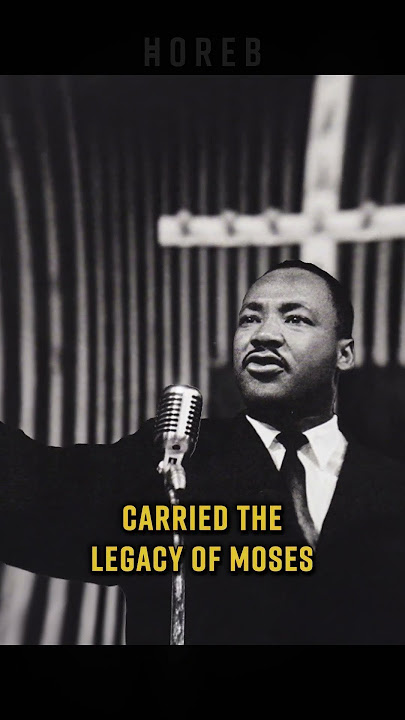
When Martin Luther King Jr. delivered his final speech, “I’ve Been to the Mountaintop” on April 3, 1968, he peppered his rhetoric with unmistakable biblical resonance. King Institute+2American Rhetoric+2 In the closing lines he said:
“He’s allowed me to go up to the mountain. And I’ve looked over. And I’ve seen the Promised Land. I may not get there with you. But I want you to know tonight, that we, as a people, will get to the Promised Land.” American Rhetoric+2King Institute+2
The metaphor is clear. Like Moses glimpsing Canaan from Mount Nebo (Deuteronomy 34:1-4), King claims a prophetic vantage: he may not live to see justice fully realized, but he knows it is attainable.
Biblical parallels King draws on
- Deuteronomy 34:1-4: Moses climbs Mount Nebo and “God showed him all the land” before he died (he did not enter it).
- Exodus 3, 7–14: The narrative of Moses confronting Pharaoh, leading Israelites out of bondage, across the Red Sea, through the wilderness.
- Psalm 114:3: “The sea looked and fled; the Jordan turned back.” (Often used in spirituals and sermons to evoke crossing from slavery to freedom.)
- Spirituals like “Go Down Moses” explicitly link Israel’s deliverance to Black American freedom. Wikipedia
King does not recite these verses explicitly in “Mountaintop,” but the allusion is unmistakable—he casts himself as prophetic leader, the Black community as the Israelites, and the moral arc of history as bendable toward justice.
Casting U.S. as Egypt, Black people as Israel
In that same speech, King takes a sweeping historical journey:
“If I were standing at the beginning of time … the Almighty said to me, ‘Martin Luther King, which age would you like to live in?’ I would take my mental flight by Egypt … and I would watch God’s children … trek from the dark dungeons of Egypt through … the wilderness on toward the Promised Land.” ABC News+2Culture Type+2
Here King explicitly envisions a metaphorical “Egypt” from which God’s people must be delivered. That is a bold rhetorical move: he positions Black Americans as enslaved, wandering, oppressed, looking toward deliverance.
He then marches through classical Greece, Rome, the Renaissance, the Reformation, Abraham Lincoln’s era — but his first pivot is to Egypt. That signals that he sees the U.S. (or aspects of it) as a modern Pharaoh’s domain, a place of chains, tyranny, and injustice, from which a movement must be freed. The Guardian+2ABC News+2
Across his body of work, King frequently uses Exodus imagery. A theological commentary notes:
“Martin Luther King Jr. often used the Exodus narrative in his struggle for civil rights.” cstsr.org
A sermon draft by King even goes so far as:
“Get out of Egypt! … Go out and leave your Egyptian dead. … Your ultimate destiny is the promised land.” King Institute
So the Exodus frame is not incidental — it is core to his prophetic logic.
Why this matters: prophetic identity, moral claim, urgency
By borrowing the Moses/Exodus script, King positions himself not just as an activist but as a spiritual emissary. The moral authority of God, divine mandates, covenant, judgment—all are embedded in his vision. To his audience, this rhetoric asserts that the struggle is not merely political but cosmic, eternal, righteous.
That also reframes the United States not as neutral terrain but as a site of oppression. In this frame, laws, institutions, customs that deny Black humanity become Pharaoh’s commands, and the struggle for equality becomes deliverance.
By likening Black Americans to Israel, King reminds his listeners: history, Scripture, and divine justice are on their side. The promise is real. The promised land can be reached — if the people stay faithful, patient, militant in love, and demand more.
Caveats and complexity
- King does not always present himself as Moses in every speech, and he rarely claims to lead in the same way (he rejects authoritarian tropes).
- The risk is that the Moses analogy can suggest passivity (waiting) rather than insurrection — but King fuses it with active nonviolent resistance.
- Some critics see danger in a messianic posture; King sometimes flirts with it (as in “mountaintop”) but generally grounds his mission in Christian humility.
King’s prophetic imagery became hauntingly literal the very next day. On April 4, 1968, less than twenty-four hours after declaring that he had “been to the mountaintop” and “seen the Promised Land,” Martin Luther King Jr. was assassinated on the balcony of the Lorraine Motel in Memphis, Tennessee. The man who had cast himself as a modern Moses glimpsing freedom but not entering it died before the movement reached its next phase. For millions, his death sealed the parallel: like Moses viewing Canaan before his passing (Deuteronomy 34:4-5), King’s vision of deliverance for Black America was real, but he would not live to see it fulfilled. His final words became both prophecy and epitaph, forever linking his legacy to the biblical story of a leader who led his people out of bondage and fell before the threshold of the Promised Land.

102 Comments
AI Girls Video
Your article helped me a lot, is there any more related content? Thanks!
Promote, refer, earn—join our affiliate program now!
Thanks for sharing. I read many of your blog posts, cool, your blog is very good. https://www.binance.com/register?ref=IXBIAFVY
Share your link and rake in rewards—join our affiliate team!
Your point of view caught my eye and was very interesting. Thanks. I have a question for you.
Can you be more specific about the content of your article? After reading it, I still have some doubts. Hope you can help me.
Thank you for your sharing. I am worried that I lack creative ideas. It is your article that makes me full of hope. Thank you. But, I have a question, can you help me?
Your point of view caught my eye and was very interesting. Thanks. I have a question for you. https://accounts.binance.info/uk-UA/register-person?ref=XZNNWTW7
Monetize your influence—become an affiliate today!
Can you be more specific about the content of your article? After reading it, I still have some doubts. Hope you can help me. https://www.binance.info/register?ref=IHJUI7TF
Sign up and turn your connections into cash—join our affiliate program!
Your article helped me a lot, is there any more related content? Thanks! https://accounts.binance.info/de-CH/register?ref=W0BCQMF1
Start profiting from your traffic—sign up today!
I don’t think the title of your article matches the content lol. Just kidding, mainly because I had some doubts after reading the article.
Can you be more specific about the content of your article? After reading it, I still have some doubts. Hope you can help me.
Can you be more specific about the content of your article? After reading it, I still have some doubts. Hope you can help me.
Your article helped me a lot, is there any more related content? Thanks!
I don’t think the title of your article matches the content lol. Just kidding, mainly because I had some doubts after reading the article.
Earn passive income with every click—sign up today!
Your article helped me a lot, is there any more related content? Thanks! https://accounts.binance.com/pl/register?ref=UM6SMJM3
Sign up for our affiliate program and watch your earnings grow!
Your point of view caught my eye and was very interesting. Thanks. I have a question for you.
Thank you for your sharing. I am worried that I lack creative ideas. It is your article that makes me full of hope. Thank you. But, I have a question, can you help me?
Can you be more specific about the content of your article? After reading it, I still have some doubts. Hope you can help me. https://www.binance.com/register?ref=JW3W4Y3A
Your point of view caught my eye and was very interesting. Thanks. I have a question for you.
Thanks for sharing. I read many of your blog posts, cool, your blog is very good.
Share our products and watch your earnings grow—join our affiliate program!
Your article helped me a lot, is there any more related content? Thanks! https://www.binance.info/ar-BH/register?ref=UT2YTZSU
8xbet を使用する前に必ずレビューを確認してください。Visit us: 8xbet 存款奖金赌场
ऑनलाइन कई चर्चाएं service-centre.in.net के जोखिमों पर प्रकाश डालती हैं। छिपे हुए स्वामित्व और नए डोमेन वाले जुआ प्लेटफ़ॉर्म अक्सर निकासी की समस्याओं का कारण बनते हैं।Visit us: service-centre.in.net 信任问题:为什么 8XBet 存在问题历史
ユーザーは kadwyn.za.com に対して細心の注意を払う必要があります。入金ボーナスに関しては典型的な緊急戦略を採用し、銀行振込と電子ウォレットをサポートしていますが、所有者は完全に隠蔽されており、ドメインはまだ数日しか経っていません。Visit us: kadwyn.za.com 信任问题:8XBet 密码更改和提款被阻止的历史记录
पोर्नज़ोन.एसए.कॉम के बारे में चेतावनियाँ तेजी से फैल रही हैं। यह ताज़ा 2026 डोमेन गोपनीयता सुरक्षा का उपयोग करता है और इसमें शून्य वास्तविक उपयोगकर्ता प्रतिक्रिया है – क्लासिक संकेत यह जमा चुरा लेगा और गायब हो जाएगा।Visit us: crypto-pl.in.net 否定的なレビュー: 現在人々をターゲットにした危険な新しいサイト
रिमूवमी.ज़ा.कॉम के बारे में चेतावनियाँ फैल रही हैं। यह ताज़ा फरवरी 2026 डोमेन पूर्ण गोपनीयता सुरक्षा का उपयोग करता है और इसकी कोई वास्तविक समीक्षा नहीं है – क्लासिक संकेत यह चोरी हो जाएगा और गायब हो जाएगा।Visit us: PROBLÈME shiirb.sa.com EXPOSÉ : le tout nouveau domaine 2026 est déjà signalé comme dangereux
8xbets.sa.com 周辺ではパニックが爆発しています。詳細が完全に埋もれた真新しい 2 月の登録 – 会社も痕跡もなく、まったくの真空状態。Visit us: Ist 8xbets.sa.com legitim? Auf keinen Fall – Unauffindbare Betrugsfalle vom Februar 2026
8xbets.in.net は詐欺行為を大音量で拡散します。 2026 年の新しいドメイン、プライバシーは厳重に保護され、ランダムな名前 – スキャナーはこれを非常に危険であると評価します。Visit us: 8xbets.in.net DRINGENDE BARGELD-LÖSCHWARNUNG: Neue Website für 2026 wird verschwinden
Promote our products and earn real money—apply today!
Refer and earn up to 50% commission—join now!
Join our affiliate community and maximize your profits—sign up now!
Your article helped me a lot, is there any more related content? Thanks!
I don’t think the title of your article matches the content lol. Just kidding, mainly because I had some doubts after reading the article.
https://shorturl.fm/QdlB9
Your article helped me a lot, is there any more related content? Thanks!
https://shorturl.fm/436MZ
Your article helped me a lot, is there any more related content? Thanks!
https://shorturl.fm/JCkDF
https://shorturl.fm/wrgCv
Thanks for sharing. I read many of your blog posts, cool, your blog is very good.
https://shorturl.fm/8cEgI
Thanks for sharing. I read many of your blog posts, cool, your blog is very good.
I don’t think the title of your article matches the content lol. Just kidding, mainly because I had some doubts after reading the article.
https://shorturl.fm/691z1
https://shorturl.fm/djY4e
Can you be more specific about the content of your article? After reading it, I still have some doubts. Hope you can help me.
Can you be more specific about the content of your article? After reading it, I still have some doubts. Hope you can help me. https://www.binance.bh/register?ref=IXBIAFVY
Your article helped me a lot, is there any more related content? Thanks! https://www.binance.bh/kz/futures/ref?code=K8NFKJBQ
https://shorturl.fm/KUVe2
https://shorturl.fm/pgDYh
https://shorturl.fm/xXlRz
Thank you for your sharing. I am worried that I lack creative ideas. It is your article that makes me full of hope. Thank you. But, I have a question, can you help me?
Your point of view caught my eye and was very interesting. Thanks. I have a question for you.
https://shorturl.fm/yCLuw
I don’t think the title of your article matches the content lol. Just kidding, mainly because I had some doubts after reading the article.
Thanks for sharing. I read many of your blog posts, cool, your blog is very good. https://accounts.binance.com/register/person?ref=JW3W4Y3A
Thank you for your sharing. I am worried that I lack creative ideas. It is your article that makes me full of hope. Thank you. But, I have a question, can you help me? https://www.binance.bh/register?ref=W49FLGDN
Your point of view caught my eye and was very interesting. Thanks. I have a question for you. https://www.binance.info/futures/ref?code=QCGZMHR6
Thank you for your sharing. I am worried that I lack creative ideas. It is your article that makes me full of hope. Thank you. But, I have a question, can you help me? https://www.gate.com/share/XwNAUwgM
Your article helped me a lot, is there any more related content? Thanks!
https://shorturl.fm/dBCVp
Thank you for your sharing. I am worried that I lack creative ideas. It is your article that makes me full of hope. Thank you. But, I have a question, can you help me?
Can you be more specific about the content of your article? After reading it, I still have some doubts. Hope you can help me.
https://shorturl.fm/yEdC9
Can you be more specific about the content of your article? After reading it, I still have some doubts. Hope you can help me.
Your point of view caught my eye and was very interesting. Thanks. I have a question for you. https://www.binance.bh/register?ref=QCGZMHR6
Thanks for sharing. I read many of your blog posts, cool, your blog is very good. https://www.binance.bh/register?ref=IHJUI7TF
https://shorturl.fm/dIOg9
Последние новинки музыки 2026 скачать бесплатно https://shorturl.fm/l9SWZ
https://shorturl.fm/PJiXS
Can you be more specific about the content of your article? After reading it, I still have some doubts. Hope you can help me. https://www.binance.bh/futures/ref?code=QCGZMHR6
I don’t think the title of your article matches the content lol. Just kidding, mainly because I had some doubts after reading the article. https://www.binance.com/register?ref=GGYHGRE
Can you be more specific about the content of your article? After reading it, I still have some doubts. Hope you can help me.
Your article helped me a lot, is there any more related content? Thanks!
https://shorturl.fm/y80aK
https://shorturl.fm/g8js5
Thanks for sharing. I read many of your blog posts, cool, your blog is very good. https://www.binance.bh/kz/register?ref=K8NFKJBQ
Your point of view caught my eye and was very interesting. Thanks. I have a question for you.
Your article helped me a lot, is there any more related content? Thanks!
Thank you for your sharing. I am worried that I lack creative ideas. It is your article that makes me full of hope. Thank you. But, I have a question, can you help me?
https://shorturl.fm/CdEA1
Thanks for sharing. I read many of your blog posts, cool, your blog is very good. gate io推荐奖金
Can you be more specific about the content of your article? After reading it, I still have some doubts. Hope you can help me.
Thank you for your sharing. I am worried that I lack creative ideas. It is your article that makes me full of hope. Thank you. But, I have a question, can you help me?
Your article helped me a lot, is there any more related content? Thanks! https://www.binance.bh/register?ref=IXBIAFVY
https://shorturl.fm/c5GCs
Your article helped me a lot, is there any more related content? Thanks! https://accounts.binance.com/register/person?ref=JW3W4Y3A
https://shorturl.fm/tpeaY
Your point of view caught my eye and was very interesting. Thanks. I have a question for you. https://www.binance.bh/register?ref=JW3W4Y3A
https://shorturl.fm/E8zJx
https://shorturl.fm/9ho6r
https://shorturl.fm/iwXyG
https://shorturl.fm/vEKy6
The connection between King’s mountain-and-Promised-Land imagery and Moses is especially compelling, particularly alongside the speech’s journey through Egypt, wilderness, and deliverance. Reference2Video could help educators visualize these layered biblical parallels by turning historical references and source materials into thoughtful image or vi
reference to video maker